What level of surfer are you?

What level of surfer are you?

We all want to be an amazing surfer right? I mean who wouldn’t want to be able to carve up any wave with fluidity and style like the pros do?

The truth is…most of us think we are way better surfers than we actually are. Not to burst your pipe dreams here…but we always recommend downplaying your surfing ability when booking an experience with a surf operator to ensure you don’t find yourself in a situation way above your head, or out of your depth so to speak.

To make it easy to work out which level of surfing you’re at, we have broken it down into three distinct levels and trust you’ll identify with one of these:


Beginner Surfer

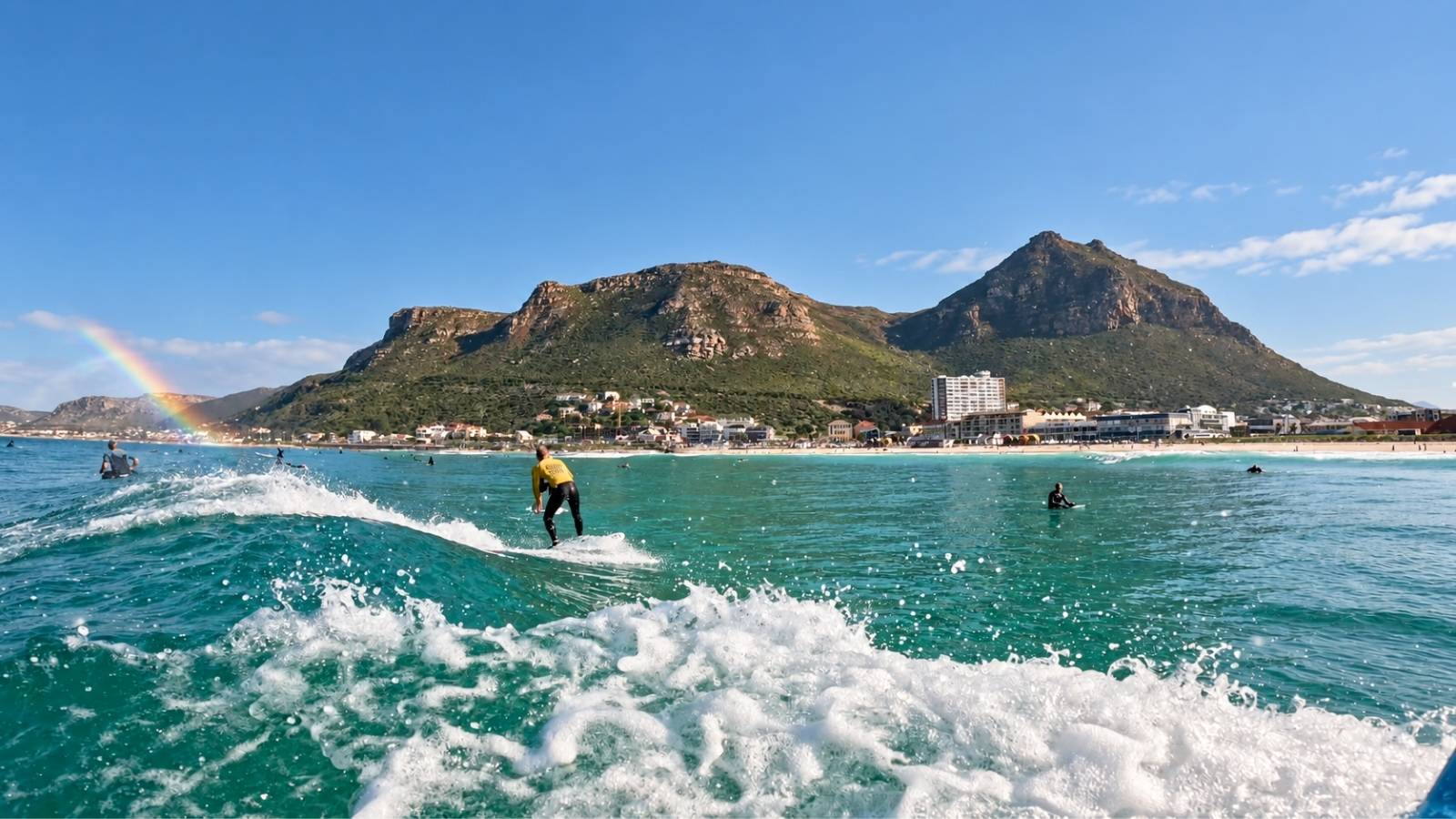
Either you’ve never touched a surfboard before or you’ve surfed a couple of times. You find yourself in waist-deep water catching broken waves (foamies) straight to the shore on a longboard or soft top. You’re still mastering the skill of the surfer’s pop up, correct paddling technique, reading the waves, and directional changes.

We recommend booking the following experiences:

Private Surf Lesson for 1:1 attention to fast-track your progress. 

Exclusive Surf Experience for an elevated surf lesson experience including a scenic stop at a view point.

Private Day Tour to combine a private surf lesson with a full day of adventuring around the Cape Peninsula and/or wine tasting at local vineyards.


Intermediate Surfer

You’ve been surfing consistently for a couple of months or years. You’re able to paddle out to the backline, comfortably sit on your board, paddle for unbroken waves, and pop up with ease. You’re most likely working on improving your duck-diving skills, wave selection, angular take-offs, generating speed down the line, and turning.

We recommend booking the following experiences:

Private Surf Lesson for 1:1 attention to work on specific skills you wish to improve on. 

Private Day Tour for a unique combination of a private surf lesson with an adventure around the Cape Peninsula and/or wine tasting.

Private Multi-day trip to adventure for several days along the East/West Coast, improving your surfing at different breaks along the way.


Experienced Surfer

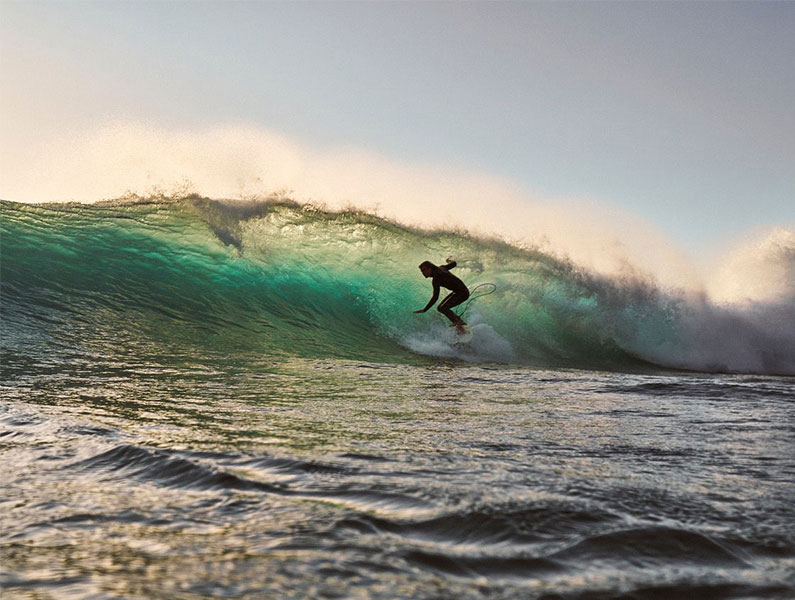
You know your way around a surfboard and surfing your local break is part of your weekly workout regime. You have your own quiver of boards, understand surf etiquette, and how to handle a busy line-up. Too many days spent out of the water leaves your gills dry.

We recommend booking the following experiences:

Private Surf Guiding for a half-day with a local surf guide getting you to the waves best suited to your preference.

Private Day Tour to combine surfing a local break with an adventure around the Cape Peninsula or wine tasting.

Private Multi-day trip for the ultimate surfari along the West or East Coast with an experienced, local surf/tourist guide.

As you can see, there is a vast difference between each level of surfing, and progressing to the next level requires lots of commitment and water time. It is important to be certain that when you consider where you are at in your surfing journey you are honest with yourself so that you get the most out of the surf experience you choose.

Contact us today to book the surf experience that best matches your ability.

Need more convincing?

Check our reviews to help make your decision.

SOUTH AFRICAN SURFING HISTORY

SOUTH AFRICAN SURFING HISTORY

There is a vast selection of tales, that have been told and embraced along our coast, but through it all, one can piece together the stories of various South African legends.

These legends, will go on to transform the sport of surfing in South Africa and all over the world…

From the unassuming beginnings of SA Surfing in Muizenberg, which took place in 1919 when Heather Price became the first recorder stand up surfer on our shores.

To the leaps taken by the Three Arcadians in board shaping and design.

All the way to recent years, when South Africans helped to shape the sport into the extraordinary spectacle it is today.

Heather Price: The first recorder stand up surfer in SA.

According to surfingheritage.co.za: Ross Lindsay, whose wife Kay, is Heather Price’s niece, visited Heather in Zimbabwe before she passed away.

It was there, that she told Ross emphatically that “she surfed standing up” and made it very clear that she had advanced beyond the general wave-riding technique of the day which was to lie down on wooden belly boards.

This new style of surfing, as explained in the book by Jack London: ‘The Cruise of The Snark’. A book in which he described the surfing exploits in Waikiki Beach, inspired Tony Bowman to build his own ‘surf-boats’ with only a few pictures from the Honolulu Tourist Association as a guide line for measurements.

He was joined by Lex Miller and Bobby van der Riet and eventually became known as The Three Arcadians, as they used to work on their designs, behind the Arcadia Tea Room.

All the way across the South African coastline, in Durban, things were also heating up, as the warm waters and tropical climate, summoned many holidaymakers to the beaches.

This led to the creation of the Durban Surf and Life Saving Club in 1927 and to the Pirates Surf and Life Saving Club in 1928.

These men, were capable ocean swimmers and created their own rescue techniques and patrols, due to their passion for the ocean and high regard for mass safety, whilst enjoy the bathing styles of the era.

At the time these activities involved entering the water till about chest height and body boarding or plaining on wooden-belly boards for the more daring.

As with any club, the Surf and Life Saving Clubs in Durban had keen pseudoscientists, one of whom was Fred Crocker, a railways carpenter and member of Pirates SLSC who by the mid 1930’s was experimenting with diverse craftsmanship tasks.

The birth of stand up surfing came after the Empire Games which took place in Sydney Australia in 1938.

The South African swimming coach and member of Durban Surf LSC, Alec Bulley had visited a Sydney beach to see what lifesavers were doing in Australia and he sketched the stand-up wave riding craft lifesavers were using.

He gave his sketches to Fred Crocker of Pirates SLSC, who built a ‘ski’ which in the Souvenir Program of SA Surf Life Saving Championships hosted by Pirates SLC at Country Club Beach, Durban. 21 April 1957 it is reported as being:

Twelve feet long and two feet, six inches wide and it tapered back and front, with a boarded over deck and flat bottom.

This made the ‘Ski’ very heavy, and it needed two men with a lot of courage and energy to handle it.

Fred Crocker tinkered with his design, making it lighter and altering the size until the “Crocker” ski, was eventually hailed as the ideal craft to ride any size or type of wave.

SA has had a major impact on surfing, which is, sadly, often overlooked. This however was not the case in the glorious eras of the 60s and 70s when a fresh breath of air was given to surfing.

With epic movies, such as Bruce Brown’s ‘The Endless Summer’, which introduced the world to some of the greatest surf spots on earth and to the surfer’s dream.

This movie depicted some of the waves around the magnificent South African coastline.

At a time when Muizenberg was the epicenter of surfing culture in the Cape, as was Durban in Natal, Bruce Brown’s movie, introduced the world to the then-unknown break in Cape St. Francis, which quickly became one of the world’s most famous surfing sites.

This part of the South African coastline is also home to an other world class South African Break and playground of the South African leg of World Surf League (WSL) Championship.

The beautiful surfer town known as Jeffrey’s Bay, or J-bay.

J-Bay, has hosted world class surfers over the years. Surfers such as Kelly Slater, Mick Fanning and South Africa’s own Jordy Smith, to name a few.

This small town has breaks for all levels of surfers. From the surreal Supper Tubes to the calmer main beach break, surfing enthusiasts will not be disappointed.

South Africa’s history with surfing has never been more evident, then it was in the 2009 documentary by Jeremy Gosch: ‘Bustin’ Down The Door’.

“During the winter of 1975 in Hawaii, surfing was shaken to its core. A group of young surfers from Australia and South Africa sacrificed everything and put it all on the line to create a sport, a culture, and an industry that is today worth billions of dollars and has captured the imagination of the world. With a radical new approach and a brash colonial attitude, these surfers crashed headlong into a culture that was not ready for revolution. Surfing was never to be the same again.” Written by Dan Schreiber, resourced from IMDB.

Shaun Tomson (SA)

Mark Richards (AUS)
Rabbit Bartholomew (AUS)

I truly believe that South Africa has been a fundamental part in the evolution of surfing, although, it is occasionally over looked by its people.

However with the increasing of popularity of the sport, athletes representing South Africa in both Longboarding and Short board championships and a mentality which forces you to go in search of your best wave, I am sure it will not be the last time South Africa makes surfing headlines.

SURFING IN CAPE TOWN

SURFING IN CAPE TOWN

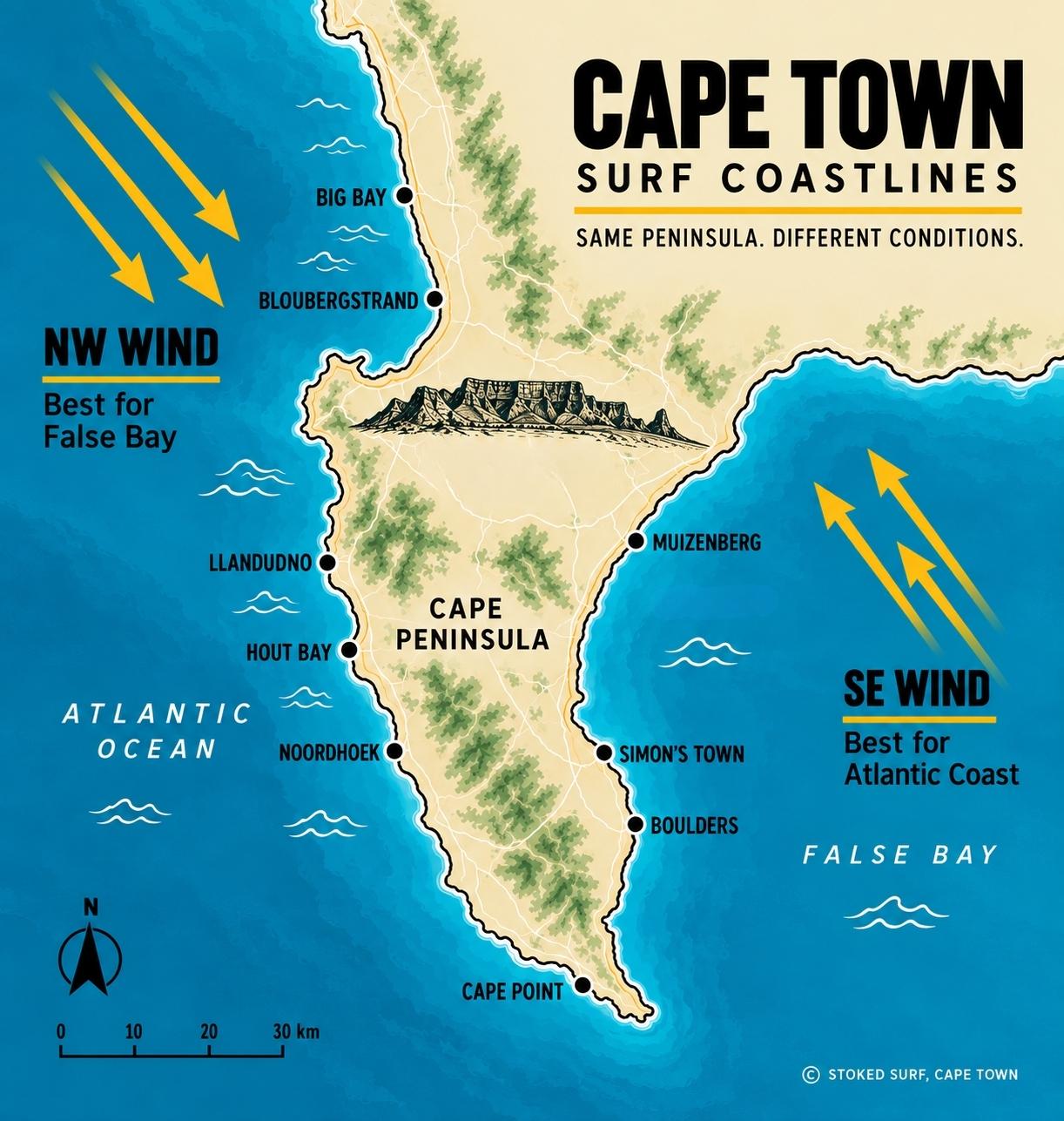
As Capetonian surfers we are spoilt for choice when it comes to choosing a spot to surf. The way the Cape Peninsula juts out into the Atlantic ocean creates two defined coastlines known locally as ‘the Atlantic’ and ‘False Bay’ sides.

The Atlantic side of the Peninsula would include spots such as Big Bay (Bloubergstrand) and Milnerton. The ‘False Bay’ side would include Muizenberg and Strand. There are an array of other surf spots along these coasts, however we have only made mention of those spots suitable for beginner to intermediate surfers.

Once you have done our ‘Uber-Stoked’ 4- surf lesson package and feel confident to paddle out into the appropriate beginner surf on your own, it’s time to start understanding the way the geography of the Cape Peninsula affects the prevailing wind and swell conditions (and in turn the surf).

Starting with the element we as Capetonians are very familiar with-the wind

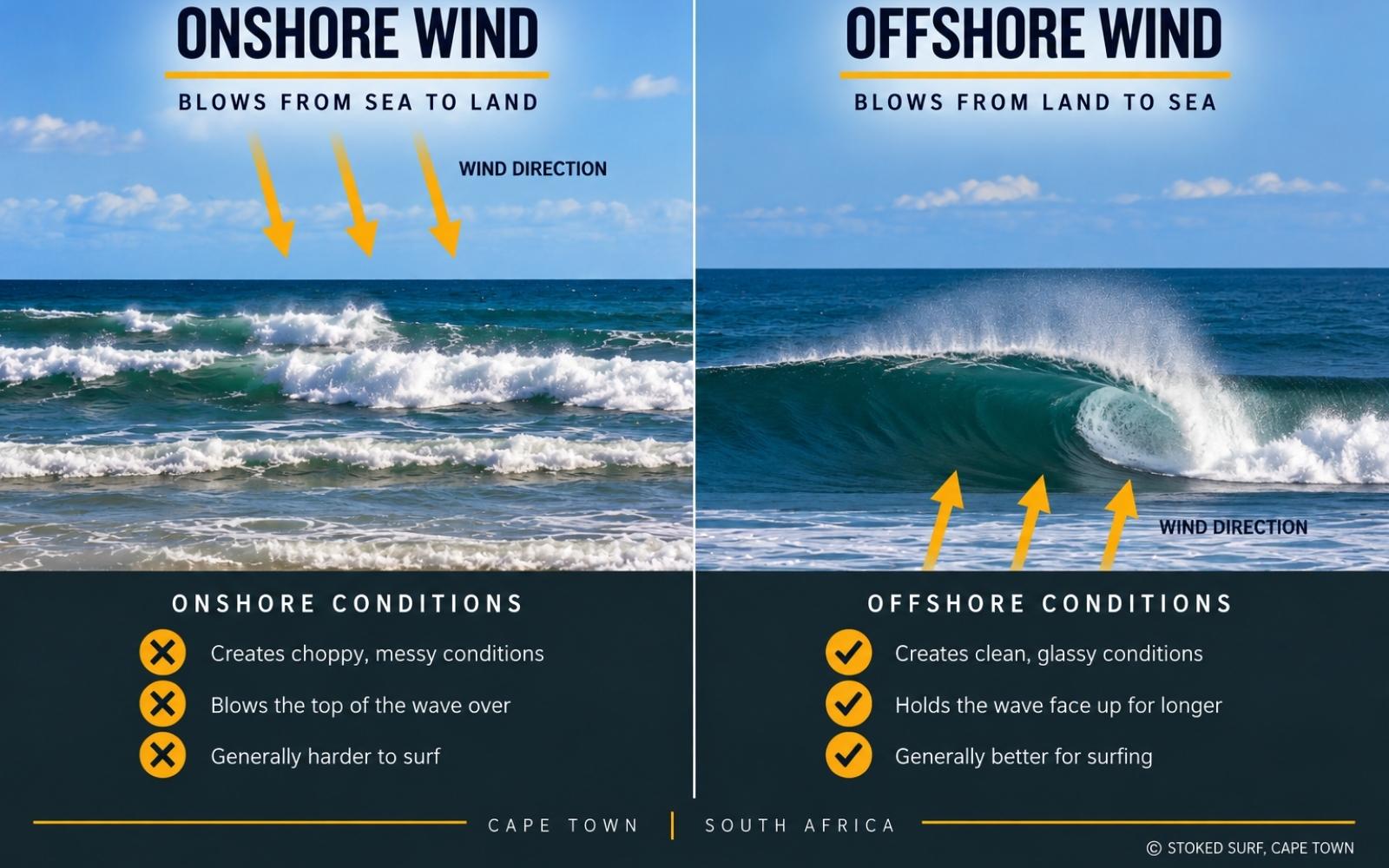
An ‘offshore’ wind is a wind that blows from the shore to the ocean. Generally, this is the most desirable wind condition for most surf spots as an offshore wind grooms the face of the wave into a smooth wall and assists in ‘holding’ the wave up so one can usually surf it longer. Offshore winds are characterized with a plume of white spray blowing off the back of a wave.

Wind is named from the direction from which it blows i.e. a South Easterly wind blows from the South East. If you look at the diagram below, it is clear that a South Easterly wind will result in ‘onshore’ conditions on the False Bay coast, and ‘offshore’ conditions on the Atlantic coast. The converse is true when a North Westerly wind blows i.e. it will be ‘onshore’ along most beaches on the Atlantic Coast and ‘offshore’ in False Bay. This is a very general statement. When you improve your level of surfing and start venturing out to other surf spots, you may find certain spots along these coastlines that ‘work’ in supposedly onshore conditions.

Swell direction (along with height and period) is the other factor one needs to consider when choosing a spot to surf. Swell is generated by low pressure systems that form along the ‘Roaring Forties’ i.e. at 40 degree south of the equator. The high winds that are generated by these low pressure systems displace of water (in a similar fashion to the ripple effect that is created when you blow on the surface of your cup of coffee). This displacement of water sends out powerful ‘ripples’ or bands of swell into the ocean.

This swell then moves until it finds landfall. The trough’s of the swell are slowed down by the continental shelf (ocean floor), causing the crests to catch up resulting in a breaking wave.

The beaches where one will find the best waves, will depend on the direction in which the swell approaches the Peninsula as well as the wind that is blowing at the time. i.e. generally, a South Westerly/Westerly swell (the most predominant swell direction along the Cape Peninsula) with a period of 12s or more, combined with a South Easterly wind produces better waves along the Atlantic Coast.

However, these are broad statements. As you gain further insight into how waves are affected by the local geography and meteorology, you will find protected bays that shelter certain winds or that are exposed to any bit of swell that hits the Peninsula. These are kept as local’s secrets, the right of passage being many hours in the frigid Atlantic waters and many kilometers driven in search of the best spots.

There are various websites you can consult before hitting the road. At Stoked, we use a combination of www.windguru.com, and www.surfline.com There are also webcams set up around the Peninsula which you can find here:

If the surf is up, load up the boards and hit the road with a flask of coffee and some good tunes. As Cape Town surfers we often look for greener pastures hoping that the waves in the next bay will be better than our first spot check. Conditions can change quickly. We have learnt that if there are good enough waves in front of you, stop your search and paddle out. The only way to know-is to go.