If you are visiting Cape Town and already surf independently, going out with a local surf guide can save a great deal of time driving around looking for waves and help you surf locations suited to both the conditions and your ability.
Already an independent surfer? Explore our Private Surf Guiding in Cape Town.
When Is the Best Time of Year to Surf in Cape Town?
You can surf in Cape Town throughout the year.
There isn’t one single “best” month because the ideal time depends heavily on your surfing ability and the type of waves you are looking for.
Surfing Cape Town in Winter
Cape Town’s winter months generally bring larger and more consistent swell generated by storms in the Southern Ocean.
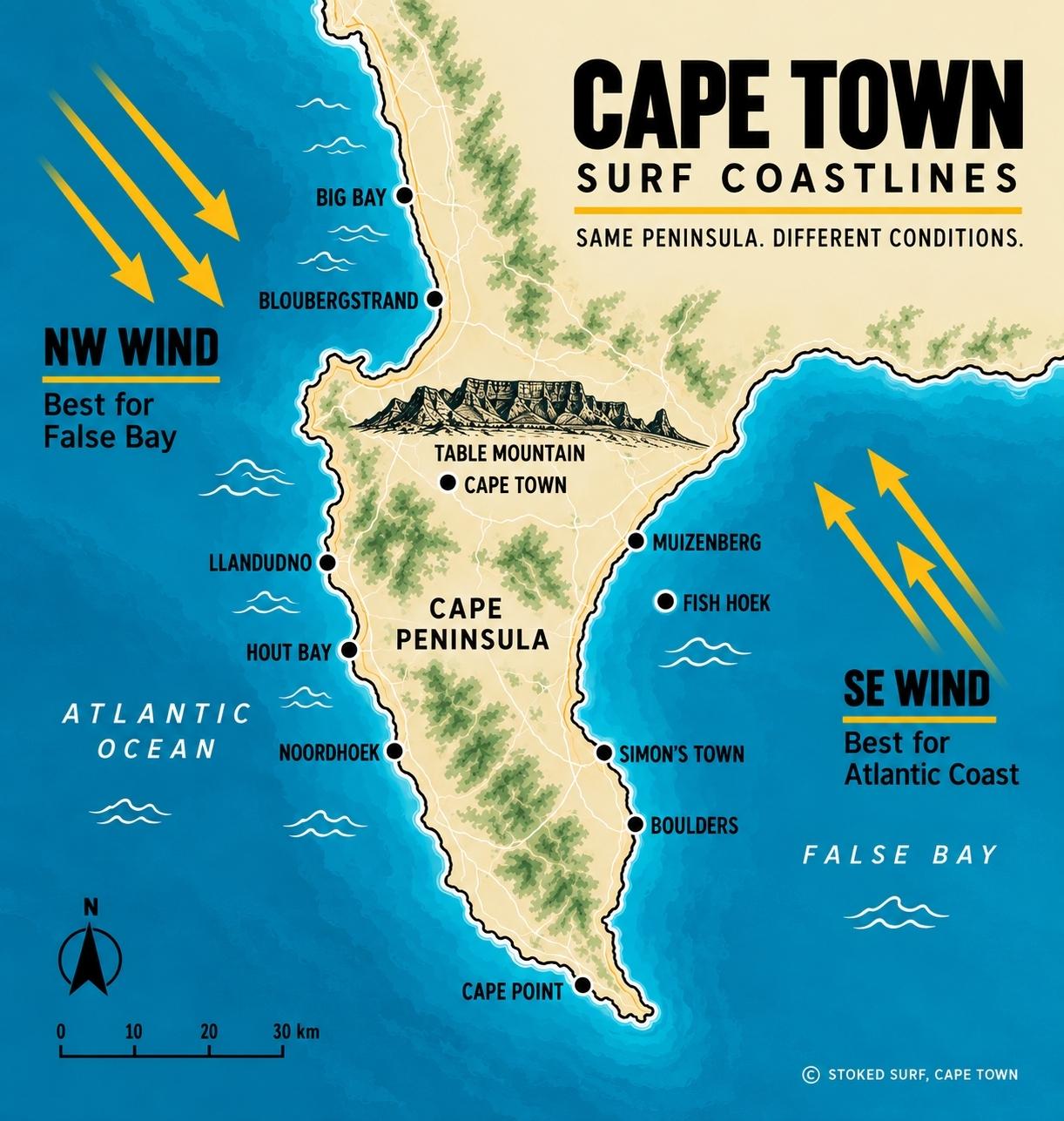
Winter also brings more north-westerly winds, which can produce clean offshore conditions at Muizenberg and other False Bay surf spots.
For experienced surfers looking for more powerful surf, winter can be an excellent time to visit Cape Town.
Surfing Cape Town in Summer
Summer brings warmer weather but also Cape Town’s famous south-easterly wind.
This doesn’t mean there is no surf.
It means knowing where to look becomes particularly important.
For beginners, the best day matters more than the best month. Suitable wave size, wind and tide have a much greater influence on the quality and safety of your surf session than the season alone.
Do You Need a Wetsuit to Surf in Cape Town?
Yes, we recommend surfing in a wetsuit in Cape Town throughout the year.
The Atlantic coastline is particularly cold due to the influence of the Benguela Current, and the water can feel surprisingly chilly even on a hot summer day.
False Bay is generally warmer than the Atlantic side, but a wetsuit still makes surfing considerably more comfortable.
For our private surf lessons, Stoked Surf provides 4:3 mm wetsuits, so you don’t need to travel to Cape Town with your own surfing equipment.
How Do We Decide Where to Surf?
There is no single Cape Town surf beach that is best every day.
Before heading out, we look at:
- Wind direction and strength
- Swell size
- Swell direction
- Swell period
- Tide
- Surfing ability
- Local conditions
Forecasting websites are extremely useful, but forecasts only tell part of the story.
After years of surfing Cape Town, we’ve learnt that conditions can change quickly. Sometimes the waves in the next bay really are better. Other times, there are perfectly good waves right in front of you.
If you’re surfing independently, check the forecast, read the conditions and know your limits.
And if there are good waves in front of you, paddle out.
The only way to know is to go.